
Rugby Betting
Test Rugby Betting in South Africa 2026
Test rugby betting is about far more than choosing which team will win. This guide breaks down the key markets, odds, settlement rules, match-day factors, and more.
 Fact checked by
Amy Clark Managing Editor
Fact checked by
Amy Clark Managing Editor
Test rugby betting is where national pride meets a betting board that can get complicated very quickly. You aren’t only choosing whether the Springboks will win. You can bet on the margin, total points, first try scorer, team totals, half-time result and dozens of match events, depending on what the bookmaker opens for that fixture.
This guide explains how Test rugby betting works in South Africa, which markets matter, what can move the odds and where the traps usually sit. We also compare five locally licensed sportsbooks to help you find the best one for betting on Test rugby in SA.
Test Rugby Betting: Quick Facts
Here’s the short version before we get into the mauls, margins and moving lines.
| Quick question | Straight answer |
|---|---|
| Is Test rugby betting legal in South Africa? | Yes, if you are 18 or older and use a bookmaker licensed by a South African provincial gambling board. |
| What is the simplest Test rugby bet? | The match result is the easiest starting point, although you must check whether the draw is included. |
| How long do most rugby bets cover? | Most standard markets are settled on 80 minutes plus stoppage time, unless the market rules say otherwise. |
| What are the most common markets? | Match result, handicap, total points, winning margin, team totals and try-scorer bets. |
| When should you check the odds? | Compare prices when markets open, after the team announcements and again shortly before kick-off. |
| Which sportsbook ranks first here? | World Sports Betting is our top Test rugby pick because its official platform combines international rugby coverage, live betting and Cash Out on eligible bets. |
What Is Test Rugby Betting?
Test rugby betting means placing a bet on an official senior international rugby union match. Most Tests are played between national teams. For South Africans, the betting interest usually centres on the Springboks against sides such as New Zealand, Australia, England, Ireland, France or Argentina.
The word “Test” matters. It separates senior internationals from club and provincial rugby such as the URC, Currie Cup and European competitions. The laws on the field are still rugby union laws, but the betting context changes because national squads assemble for shorter windows, combinations have less time together and selection can swing sharply from one week to the next.
Test rugby markets are offered at fixed odds. You choose a selection, enter a stake and accept the displayed price. If the bet wins under that bookmaker’s settlement rules, your return is the stake multiplied by the decimal odds.
For example, a R100 bet at 1.90 returns R190 if it wins. The profit is R90 because the other R100 is your original stake coming back.
Is Test Rugby Betting Legal in South Africa?
Yes. Fixed-odds betting on Test rugby is legal for adults in South Africa when the wager is placed with a locally licensed bookmaker. You must be at least 18, complete the operator’s identity checks and use an account registered in your own name.
An overseas licence doesn’t replace a South African bookmaker licence. Check the legal entity and provincial licence in the site’s footer or terms, then confirm it with the relevant regulator if anything looks unclear. The National Gambling Board provides national regulatory information, while provincial boards license and supervise bookmakers.
Our broader guide to rugby betting in South Africa covers the legal framework and basic betting process in more detail.
How to Bet on a Test Rugby Match
The mechanics are simple once your account is open and verified. To help you get started, we’ve outlined the steps you need to take to create an account on sports betting sites in South Africa.
How to get started
8 practical steps- Create and verify your account Enter accurate personal information and complete the required FICA checks.
- Deposit in rand Use an available payment method registered in your name where required, and stick to a budget decided before you open the markets.
- Open Rugby Union International fixtures may appear under Rugby Union, International, World or the name of the tournament.
- Select the Test Check the teams, venue, kick-off time and whether the market is pre-match or live.
- Choose the market Tap the price for the match result, handicap, total or other selection you want.
- Read the market label Make sure you know whether the draw, extra time or a specific match period is included.
- Enter the stake and review Check the odds, line, potential return and settlement wording before confirming.
- Check your bet history Confirm that the bookmaker accepted the bet at the recorded price. Don’t submit it twice because the first confirmation loaded slowly.
Test Rugby Betting Odds Explained
South African sportsbooks normally use decimal odds. They show your total potential return for every rand staked, including the stake. To give you an idea of what to expect, we’ve provided a simple example below:
| Selection | Example odds | R100 potential return |
|---|---|---|
| Short-priced favourite | 1.35 | R135 |
| Near-even selection | 1.95 | R195 |
| Underdog | 3.5 | R350 |
Lower odds indicate the outcome the bookmaker considers more likely. They don’t make that outcome safe. A favourite at 1.20 can lose just as completely as an underdog at 5.00; the shorter price only changes the expected return.
You can turn decimal odds into an implied probability by dividing 1 by the odds. A price of 2.00 implies 50%, while 1.50 implies roughly 66.7%. The bookmaker’s margin means the percentages across every selection usually add up to more than 100%.
That margin is why comparing the exact same Test rugby market across sportsbooks matters. If the Springboks are listed at 1.80 in one place and 1.90 in another, a R100 winning bet returns R10 more at the higher price. It looks small on one Saturday. Repeated over a season, it stops being small.
Popular Test Rugby Betting Markets
The best market isn’t the one with the longest menu. It’s the one you understand well enough to know exactly what must happen for it to win.
How Test Rugby Bets Are Usually Settled
Most standard rugby markets are based on 80 minutes plus stoppage time, but “usually” isn’t a settlement rule. The wording on your bookmaker’s page wins that argument every time. Let’s take a look at a few possible situations and what to look out for before placing a bet.
| Situation | What to check before betting |
|---|---|
| Draw after 80 minutes | Is the draw a third selection, a push, or a losing outcome? |
| Knockout match goes to extra time | Does the market cover regulation time or the team to qualify? |
| Match is abandoned | Are determined markets settled while the rest are void? |
| Fixture is postponed | How long can the match be delayed before bets are voided? |
| Venue or opponent changes | Do existing bets stand or become void? |
| Player doesn't take the field | Is the player bet voided or settled as a loss? |
Supabets, for example, states in its official Rugby Union rules that standard rugby bets are settled on 80 minutes plus stoppage time unless otherwise stated. It also publishes separate rules for abandoned, postponed and relocated fixtures. That doesn’t mean every operator uses identical wording. It proves why the rules deserve a look before the bet, not after a disputed settlement.
World Rugby awards five points for a try, two for a conversion and three for either a penalty goal or drop goal. A penalty try is worth seven points, with no conversion attempted. Those values shape the key numbers around handicaps and totals. A seven-point lead is one converted try. An eight-point lead forces the trailing team to find more than a single scoring sequence.
Test Rugby vs Club Rugby Betting
While the rules stay the same on the pitch, international rugby shakes up the betting board in ways club rugby just can’t match.
Here is what you need to watch out for when the anthem finishes and the Test kicks off:
| Test rugby factor | Why it matters to the market |
|---|---|
| Short preparation windows | National combinations may have less time together than settled club units. |
| Selection depth | A country can replace one international with another, but the tactical role may still change. |
| Travel and altitude | Long-haul travel, time zones and Highveld conditions can affect tempo and late-game execution. |
| Series position | A decider, opener and dead rubber create different incentives. |
| Goal-kicker selection | One change can affect handicaps, totals and winning-margin markets. |
| Bench construction | A six-two or seven-one split can strengthen the pack while leaving less backline cover. |
| Referee interpretation | Breakdown, scrum and card patterns can shape territory and points. |
Club form still matters because it tells you whether players arrive sharp, injured or short of minutes. It just can’t be copied straight across. Fifteen strong individual seasons don’t automatically create one coherent Test side by Saturday.
Major Test Rugby Competitions and Betting Windows
Test rugby doesn’t run like a domestic league with the same rhythm every weekend. The market changes with the type of international window, as we’ve outlined below:
| Competition or window | What makes it different |
|---|---|
| Rugby World Cup | A long outright market leads into pool and knockout betting, where qualification and regulation-time markets must be separated. |
| Rugby Championship | Southern Hemisphere rivals meet repeatedly, making travel, rotation and tactical adjustments from earlier Tests especially relevant. |
| Six Nations | A compact European championship where outrights, match markets and table permutations can overlap. |
| Mid-year internationals | Tours and short series can produce heavy rotation, unfamiliar combinations and quick rematches. |
| End-of-year internationals | Travel, accumulated minutes and squad depth matter as Southern Hemisphere teams tour Europe. |
A competition name tells you the stakes, not the bet. In a knockout fixture, check whether you are backing the 80-minute result or the team to qualify. In a series, check whether the market is for one Test or the full series result.
What Moves Test Rugby Betting Odds?
Sportsbooks don’t just pull rugby odds out of thin air, and they certainly don’t leave them static once they are posted. Test rugby markets are highly sensitive, moving rapidly as new information comes to light throughout the week.
If you want to spot value before the lines shift, you need to track the specific catalysts that force sportsbooks to adjust their prices.
Form, Rankings and the Matchup
World Rugby’s rankings are a useful baseline because they account for match results and the relative strength of the teams involved. They aren’t a ready-made betting price. Venue, selection and the size of the expected margin still need separate work.
Don’t stop at the last result either. Check the quality of the opposition, where the Tests were played and how closely the current 23 resembles the team behind that form. Then look at the matchup itself. Scrum pressure, lineout security, exit kicking and backfield coverage can matter more than a neat five-match win-loss row.
Team Announcements
The starting XV gets the headlines, but don’t stop reading at number 15. Check the bench, the goal-kicker, the replacement front row and who covers fly-half, scrum-half and full-back.
A late change at tighthead can move a handicap for good reason. So can losing the first-choice kicker in a match expected to be decided by penalties.
Venue, Travel and Altitude
Ellis Park and Loftus Versfeld ask a different conditioning question from a coastal venue. Altitude can punish a side that can’t exit cleanly or has spent too long defending, particularly once replacements arrive and the match breaks open.
Travel isn’t an automatic fade either. Modern Test teams plan long-haul trips carefully. Look at arrival time, turnaround, recent minutes and squad rotation instead of treating a passport stamp as analysis.
Weather
Wind is often more useful than the rain icon. It affects touch-finders, contestable kicks and shots at goal. Heavy rain changes handling and footing, while a dry, fast surface can suit width and counterattack. Check the forecast close to kick-off because conditions can change after an early market opens.
Goal-Kicking
A try creates five points. The conversion isn’t automatic. In a tight Test, a kicker’s range and role can decide the match result while also pulling a total or handicap across its line.
Confirm who is expected to kick rather than relying on the number on the player’s back. Full-backs and centres can take the tee even when the fly-half starts.
Discipline and the Card Protocol
A yellow card removes a player for 10 minutes, while in elite rugby, a red card allows a replacement after 20 minutes, though intentional, highly dangerous play can still result in a permanent dismissal with no replacement.
World Rugby’s global law changes mean a “red card” does not always result in a team playing with 14 players for the remainder of the match. Markets react quickly to cards, but the real impact depends on position, time remaining, and whether a replacement will eventually restore the team to 15.
The Referee and Breakdown Picture
Don’t reduce a referee to a crude penalties-per-match number. Look at what the two teams want to do and where the official’s interpretations may collide with it.
A side that lives off breakdown pressure may struggle if it can’t release cleanly. A dominant scrum can become both a territorial weapon and a source of three-point shots. The useful question isn’t “Is this referee strict?” It is “Which part of this matchup gives the referee a decision to make repeatedly?”.
Series Context
The first Test can be cautious because neither side has seen the other’s plan at full speed. A second Test may bring targeted adjustments. A decider can squeeze risk out of the game, while a dead rubber can produce rotation and a looser tempo. That doesn’t dictate the total, but it does tell you what to investigate before accepting one.
The 80-Minute Test Read
Timing your wagers is just as important as picking the right team. Rugby odds move in distinct waves from the second the market opens right through to the final whistle.
This timeline breaks down exactly how to read a Test match as the week unfolds and the game plays out:
When the Market Opens
Start with the fixture shape. Note the venue, rest difference, travel, series position and likely strength of each squad. If you take an early price, accept that the final teams and weather may prove your read wrong.
After the Teams Are Named
Rebuild the match from one to 23. Compare the front rows, lineout callers, loose-forward balance, halfbacks, kicking options and bench cover. Count combinations, not famous surnames.
This is also the time to compare the same line across sportsbooks. One bookmaker may move quickly while another leaves an older handicap available for a little longer.
On Match Day
Check late withdrawals, the confirmed kicker, surface conditions and wind. Then read the market label one last time. “South Africa to win” and “South Africa -7.5” express very different levels of confidence.
The First 15 Minutes
If you are considering live betting, watch territory before possession. A team can hold the ball for long spells while going nowhere. Look at scrum stability, exit quality, breakdown speed and whether the referee is rewarding the contest or the carrier.
Don’t chase a price after one freak score. A chargedown try changes the scoreboard immediately; it doesn’t necessarily change which pack controls the match.
Half-Time
Ask how the points were created. A lead built from repeat scrum penalties is different from one built on two intercepts. Check which team has spent more energy defending and which bench carries the greater late impact.
Minutes 50 to 65
This is often where the replacements reshape a Test. Fresh props can reverse a scrum. A replacement scrum-half can lift the tempo. A six-two bench split can squeeze the match through forwards, but an early backline injury may leave awkward cover.
The Final Quarter
Game state takes over. A team protecting a narrow lead may kick more and play in the right areas. A side chasing two scores has to take risks, which can create both late tries and late mistakes. The market knows the score. Your job is to decide whether it understands how the score happened.
Common Test Rugby Betting Mistakes
In international rugby betting, a single lazy assumption can ruin a perfectly good ticket before half-time. Bookmakers love uneducated public money that chases big names and moving lines. To protect your bankroll, make sure you aren’t falling into these classic betting traps:
- Backing the Badge Instead of the Team Sheet: The Springbok badge doesn’t carry the ball. Players do. If a national side rotates heavily, changes its kicker or experiments with combinations, the old reputation may be less useful than the actual 23.
- Treating Every Home Match the Same: Durban humidity, Cape Town wind and Highveld altitude aren’t interchangeable. “Home advantage” is a headline. Venue-specific conditions are the evidence underneath it.
- Assuming Rain Guarantees an Under: Wet weather can lower tempo, but it can also produce penalties, cards, short fields and maul tries. Weather changes the route to points, not always the number of points.
- Ignoring the Draw: Draws are uncommon in Test rugby, not impossible. Check whether your match-result market has two selections or three and how a level score is settled.
- Building a Multi From Short-Priced Favourites: Five selections at skinny odds can still create one fragile ticket. Each extra leg adds another way to lose. A short price tells you what the market expects; it doesn’t turn an upset off.
- Betting Live Because the Price Is Moving: Movement creates urgency, and urgency is exactly where careless bets breed. Decide what signal you are waiting for before kick-off, such as scrum dominance or a tiring defence. If it never appears, leave the market alone.
Best Test Rugby Betting Sites in South Africa
We ranked these sportsbooks after testing a range of options available to local bettors. We looked for a South African licence, an identifiable rugby section, international or live coverage, usable mobile access and clear betting rules. Keep in mind that market availability changes by fixture, so always inspect the event page before depositing for one specific bet.
| Rank | Sportsbook | Why it makes the list |
|---|---|---|
| 1 | World Sports Betting | Dedicated international rugby route, live betting, eligible Cash Out and data-free betting |
| 2 | ZARBet | Locally licensed platform with sports betting, live bets and official Android app and optimized mobile web access |
| 3 | Betway | Dedicated rugby pages, pre-match and live betting, plus a data-free app option |
| 4 | Hollywoodbets | Dedicated rugby hub, separate live in-play rugby page and an official betting app |
| 5 | Supabets | Light-data Android app and clearly published Rugby Union settlement rules |
World Sports Betting: Our Top Pick for Test Rugby
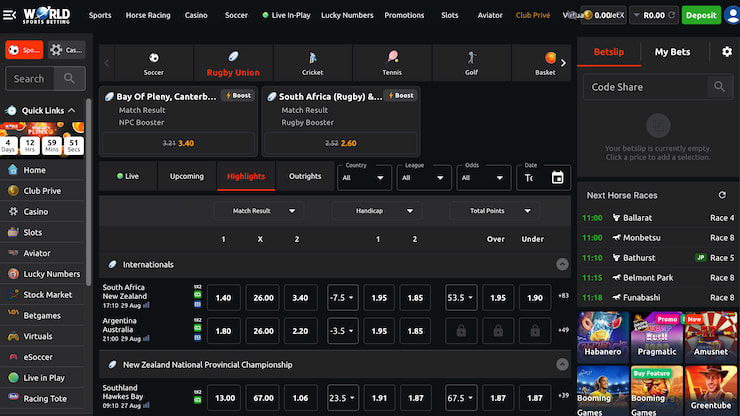
World Sports Betting earns our number-one position because its official sportsbook gives international rugby a dedicated route instead of burying Tests inside a generic sports list. WSB also confirms live betting on rugby union and offers Cash Out for eligible online bets. That combo gives you a sensible path from an early Test price to the moving market once the match begins, although neither live markets nor Cash Out should be assumed for every selection.
Its official app page lists Android, iPhone and Huawei options alongside live in-play betting, live odds, instant EFT and card deposits. It also advertises same-day withdrawals. Those are useful practical features for a Saturday Test, especially when team news or weather changes close to kick-off. WSB is still a betting operator, not a shortcut to a winning read, so compare its price with the same market elsewhere and check the settlement rule before placing the bet. To learn more about this site and what it offers, check out our full World Sports Betting review.
- 🏆Best for: Combining international rugby navigation with live market access.
How to Choose a Test Rugby Sportsbook
The biggest logo isn’t automatically the best home for your bet. Check what matters for the way you actually follow Tests.
How to get started
5 practical steps- Compare the Exact Line Don’t compare “rugby odds” in the abstract. Put the same fixture, market and handicap side by side. South Africa -7.5 isn’t the same bet as South Africa -8.5, even if the displayed odds match.
- Check International Market Depth A sportsbook may cover every major Test but offer only a match result and handicap on smaller internationals. If you want team totals or player props, inspect an upcoming fixture before choosing the site.
- Read the Rugby Rules Look for regulation-time wording, draw treatment, postponed matches, venue changes and player non-participation. Clear rules matter most when something unusual happens.
- Test the Navigation Before Depositing Find Rugby Union, open an international fixture and locate the bet slip on your phone. If it takes five minutes while you are calm, it won’t become easier when a line is moving before kick-off.
- Treat Cash Out as Optional Cash Out is an offer from the bookmaker, not a guaranteed account feature. It may disappear, pause or return less than the original potential payout. Never build a betting plan that works only if the operator lets you exit early.
A 60-Second Test Rugby Checklist
Run through this before confirming the slip:
- Is the operator licensed in South Africa?
- Is the market settled over 80 minutes or does it include extra time?
- Does the draw count?
- Are the final teams and replacement benches confirmed?
- Who is taking the kicks at goal?
- Have you checked the venue, wind and surface conditions?
- Are you comparing the same handicap or total elsewhere?
- Do you understand what happens if a player doesn’t take the field?
- Is the stake inside the budget you set before opening the app?
If any answer is “I think so”, just stop. Betting rules are a terrible place for guesswork.
Safer Test Rugby Betting
Test rugby is designed to pull emotion out of you, which is brilliant for the stadium but dangerous for the bet slip. Set your budget before the team runs out, not after the opposition scores first.
Don’t increase a live stake to recover a pre-match loss, and don’t confuse a short-priced Springbok selection with guaranteed money. If the match is more enjoyable without another bet, close the app and watch the rugby.
Final Thoughts
Test rugby betting becomes clearer once you separate the badge from the bet. Start with the settlement period, then read the team sheet, kicker, bench, venue and weather before you decide whether the market price makes sense.
World Sports Betting is our number-one sportsbook for this page because its official platform combines a dedicated international rugby route with live betting, mobile access and Cash Out on eligible bets. ZARbet, Betway, Hollywoodbets and Supabets each offer a credible local alternative, but no single operator owns the best price on every Test.

Welcome bonus
100% first deposit match up to R20,000
New customers only. T&Cs apply.
Affiliate disclosure: StraightBet may earn a commission if you sign up through this link. This does not affect our editorial independence. 18+ only. Bet responsibly. Winners know when to stop. Get help and support.
FAQs
What is Test rugby betting?
Test rugby betting is wagering on official senior international rugby union matches. Most are played between national teams, although recognised representative sides such as the British & Irish Lions also play Tests. Common markets include the match result, handicap, total points, winning margin and try scorers.
Is Test rugby betting legal in South Africa?
Yes. Adults aged 18 or older can legally bet on Test rugby through bookmakers licensed by a South African provincial gambling board.
What is the best sportsbook for Test rugby in South Africa?
StraightBet ranks World Sports Betting first for Test rugby because its official platform has dedicated international rugby navigation, live betting, mobile access and Cash Out on eligible bets. The best site for one selection can still depend on the available line, price and market rules.
What is the easiest Test rugby market for beginners?
The match result is the simplest market because you choose which team will win. Check whether the draw is included and whether the bet covers regulation time only.
What does a rugby handicap mean?
A rugby handicap gives one team a virtual points advantage and the other a deficit. If South Africa are -8.5, they must win by at least nine points for that selection to cover the handicap.
Does extra time count in Test rugby bets?
Usually not in standard match markets, which are commonly settled after 80 minutes plus stoppage time. Markets such as “to qualify” may include extra time. Always check the bookmaker’s rules and the exact market label.
What happens if a Test match ends in a draw?
It depends on the market. A three-way match result includes the draw as its own selection. A two-way market may refund stakes or apply another rule if scores are level, so check before betting.
When do Test rugby odds change most?
Prices can move when teams are announced, after late injuries, when weather forecasts sharpen and as betting activity changes the market. Live odds then move throughout the match.
Should I wait for the team announcement before betting?
Waiting reduces uncertainty because you can assess the starting XV, bench, kicker and positional cover. An earlier price may be better, but it also carries the risk that the final team weakens your original read.
Is Cash Out always available on rugby bets?
No. Cash Out is normally limited to eligible bets and can be suspended or removed. Availability differs by sportsbook, market and stage of the match.
18+ only. Betting carries risk, so keep it within your means. This guide is written for South African residents and refers to operators licensed by provincial gambling boards under the National Gambling Act. If gambling is taking a toll on you or someone you know, the National Responsible Gambling Programme helpline is free and open 24/7 on 0800 006 008, or text HELP to 076 675 0710. Winners know when to stop.